Power Supply: Tegbe Says Nigerians Asked Him to Slow Down as Freezers Now Stay Frozen
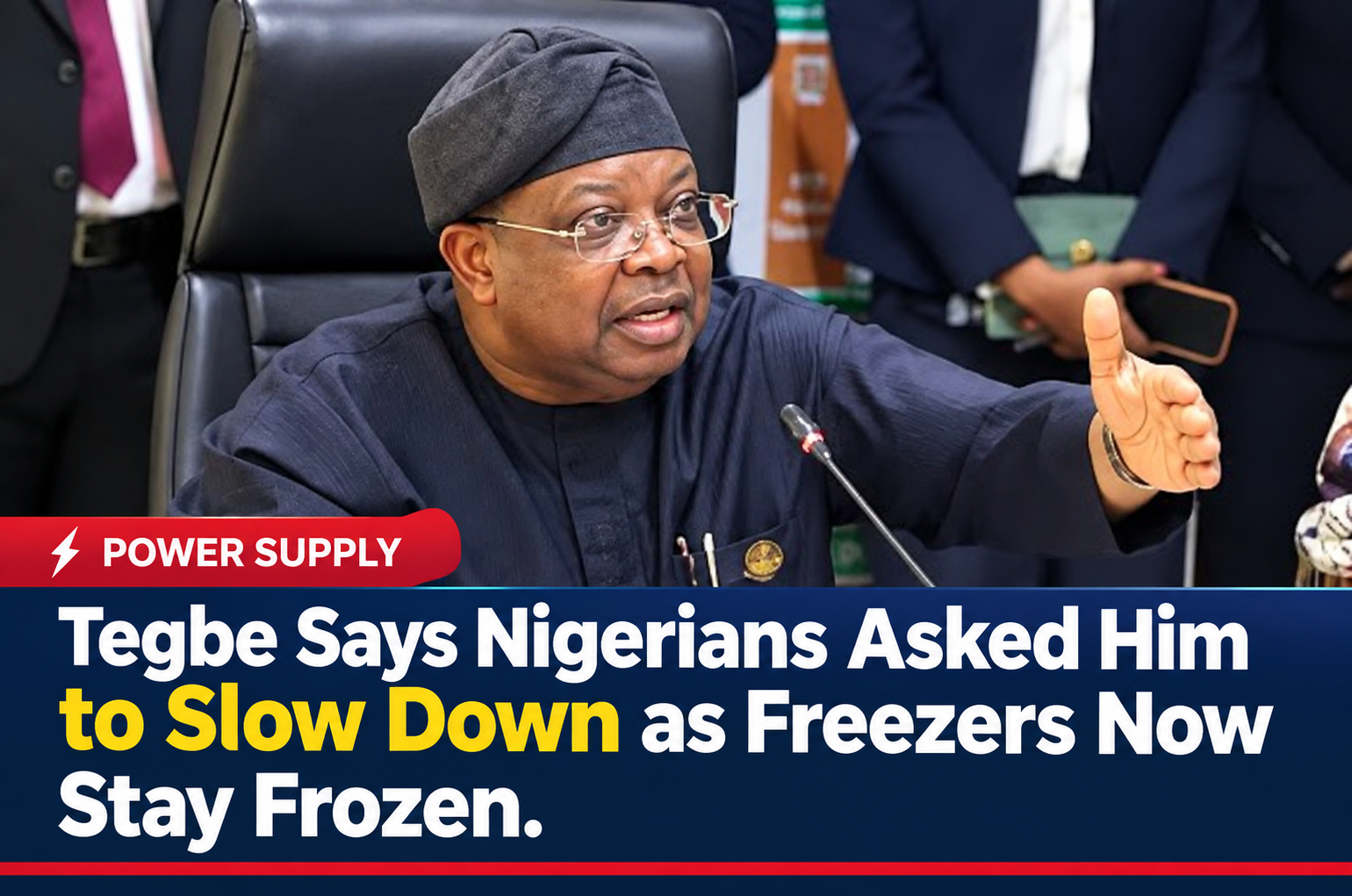
Photo Credit: Goldmyn/X
Nigeria’s Minister of Power, Joseph Tegbe, says improvements in electricity supply in some parts of the country have become noticeable enough that some consumers are jokingly asking him to slow down.
Tegbe made the comment on Wednesday in Abuja while commissioning a 3-megawatt solar hybrid power project at Yakubu Gowon University, formerly the University of Abuja.
According to the minister, some communities that previously experienced prolonged periods without electricity are now recording significantly longer supply hours, with some areas reportedly receiving up to 18 hours of electricity.
He illustrated the change by recounting feedback he said he had received from consumers whose freezers were now operating regularly.
Tegbe said some residents told him to reduce the pace of improvement because their freezers were constantly freezing their stored food. He responded that regular operation was precisely what a freezer was designed for.
The minister recalled that during his Senate screening, he had indicated that Nigerians would begin to notice improvements in electricity supply within three to six months.
Ageing infrastructure remains a challenge
Despite the reported improvements in some locations, Tegbe acknowledged that Nigeria's electricity network continues to face major infrastructure problems.
He said parts of the country's power infrastructure are more than 40 years old and that the government is working to replace ageing facilities while introducing newer equipment.
The condition of transmission and distribution infrastructure remains important because increased generation alone does not guarantee reliable electricity for households and businesses. Power must also be transmitted and distributed through infrastructure capable of carrying it safely and consistently.
Government steps up response to vandalism
Tegbe also highlighted vandalism as another threat to electricity reliability.
He disclosed that three major transmission towers in Birnin Kebbi had been brought down after vandals attacked their foundations and removed parts of the structures for scrap.
The minister said the government had established a joint working arrangement involving the Economic and Financial Crimes Commission, the Nigeria Police Force and the Nigeria Security and Civil Defence Corps to strengthen the protection of critical electricity infrastructure.
Vandalism can have consequences beyond the damaged equipment itself. When transmission infrastructure is destroyed, repairs can take time and communities connected to affected networks may experience prolonged interruptions.
3MW solar project commissioned in Abuja
The minister's remarks came as the Federal Government commissioned a 3MW solar hybrid power project at Yakubu Gowon University.
The project was delivered under Phase II of the Energising Education Programme through the Rural Electrification Agency and the Nigeria Electrification Project. Reports say the facility combines a 3.3MW solar array with 3MW of AC output capacity and battery storage, alongside 388 streetlights for the university campus.
The project is expected to provide more dependable electricity for teaching, research, laboratories, ICT facilities, administration and other university operations.
What improved electricity means for Nigerians
More reliable electricity can directly affect households and businesses. It can reduce dependence on petrol and diesel generators, help preserve food and medicines that require refrigeration, support small businesses and improve the operating environment for schools and other institutions.
However, the reported improvement in some locations does not necessarily mean that electricity reliability has been solved nationwide. Nigeria's power sector still faces challenges involving ageing infrastructure, transmission capacity, distribution networks, vandalism and other technical and operational issues.
For consumers, the significance of the minister's comments will ultimately depend on whether improvements in supply can be sustained and expanded to communities that continue to experience frequent outages.