NITDA Trains Nigerian Children in Coding, AI and Digital Skills as Future Tech Innovators
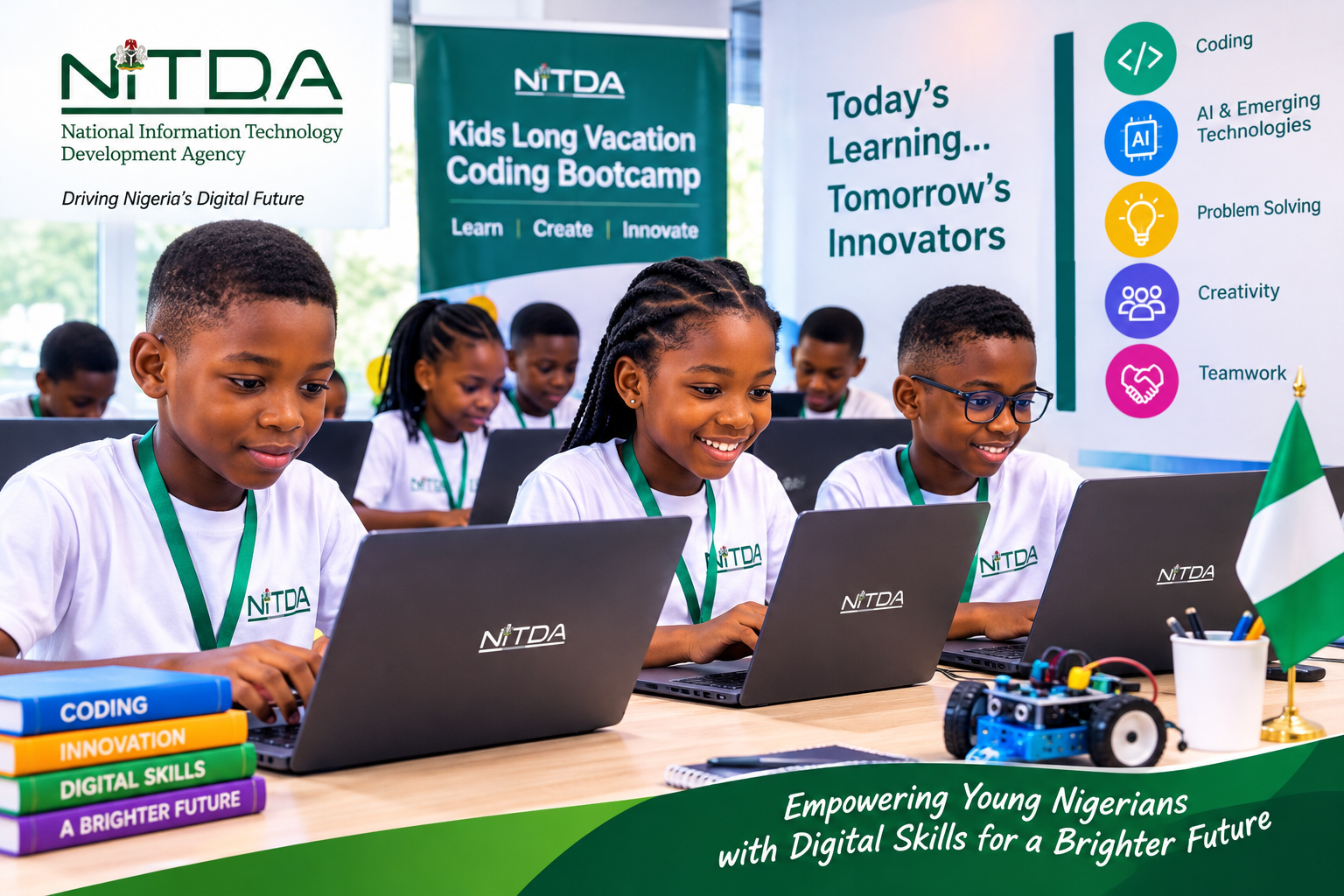
The National Information Technology Development Agency (NITDA) is expanding early exposure to technology among Nigerian children through its 2026 Kids Long Vacation Coding Bootcamp, giving young participants practical experience in coding, computational thinking, digital creativity and emerging technologies. The programme is part of a broader effort to prepare younger Nigerians for an economy that is increasingly dependent on digital skills. Recent NITDA updates show that the 2026 bootcamp has already been completed in Kano, Kwara, Jigawa and Gombe, while related training activities were still ongoing in parts of the South-South, South-East and South-West at the time of the agency's latest update.
This means the programme is being implemented beyond a single city or region, although the available NITDA update does not yet establish that the same bootcamp has been completed across all six geopolitical zones. That distinction is important when reporting the programme.
What are the children learning?
The bootcamp goes beyond simply teaching children how to write computer code. According to NITDA, participants are being introduced to coding, computational thinking, digital creativity and emerging technologies, while also developing skills such as critical thinking, collaboration, creativity, persistence and problem solving.
These skills can help children understand technology as something they can create with, rather than merely something they consume. Instead of only using smartphones, computers and digital platforms to watch videos or access social media, children can begin learning how software, digital products and technological solutions are developed. NITDA's wider programmes also show an increasing emphasis on emerging technologies. Its National Centre for Artificial Intelligence and Robotics (NCAIR), for example, has been involved in programmes ranging from STEM training for children to artificial intelligence and virtual/augmented reality training. NITDA has said NCAIR has trained more than 3,000 Nigerians in emerging technologies.
Why starting with children matters
Nigeria's digital economy will require people with relevant technical skills, and developing those abilities early can give young people more time to experiment, make mistakes and improve. The importance goes beyond employment. A child who learns computational thinking can develop the habit of breaking complicated problems into smaller parts and looking for logical solutions. Creativity and collaboration can also help children work effectively on technology projects and entrepreneurial ideas later in life. NITDA's broader digital skills programmes demonstrate the government's attempt to build a pipeline of talent. Its 3 Million Technical Talent (3MTT) programme, for example, focuses on technical skills including artificial intelligence/machine learning, software development, data science, cybersecurity, cloud computing and other fields.
The children's bootcamp therefore fits into a much larger digital skills ecosystem.
The potential impact on Nigerian children
- It can introduce technology at an early age Early exposure can help children develop confidence around computers and technology instead of seeing coding and other technical fields as subjects meant only for university students or professionals.
- It can encourage problem solving Coding requires learners to identify problems, test solutions and correct mistakes. NITDA specifically highlighted persistence and problem solving as part of the skills developed through the programme.
- It can create future innovators Some participants may eventually develop applications, digital businesses or technological solutions to Nigerian problems. Today's child learning basic programming could potentially become tomorrow's software developer, cybersecurity specialist, AI engineer, entrepreneur or technology researcher.
- It can help Nigeria build a stronger digital workforce Nigeria's technology sector needs skilled people across numerous fields. Creating a pipeline of young learners could help expand the pool of future technical talent.
- It can reduce the digital skills gap An important issue is ensuring that opportunities to learn technology are not restricted to children from wealthy families who can afford expensive private coding schools. A government backed programme that reaches different parts of Nigeria has the potential to expose children from different backgrounds to skills they might otherwise not encounter. But training alone is not enough The long-term success of programmes like this will depend on what happens after the bootcamp. A few weeks of training can introduce children to technology, but sustained progress requires access to computers, internet connectivity, electricity, teachers, mentorship and opportunities to continue practising. Parents and guardians also have an important role. NITDA's Director General, Kashifu Inuwa, recently urged parents to continue supporting participants after the bootcamp, stressing that encouragement and responsible exploration of technology can determine whether the skills gained become temporary knowledge or develop into lasting interests and careers.
This is perhaps one of the most important aspects of the programme: the bootcamp should be viewed as a starting point, not the final destination. What this means for parents and citizens Parents whose children participate should encourage them to continue experimenting with what they have learned. Instead of allowing the experience to end with a certificate, parents can encourage children to:
-
. Build simple projects.
-
. Continue learning coding.
-
. Explore responsible uses of AI.
-
. Participate in technology competitions.
-
. Work with other young learners.
-
. Ask questions and experiment with digital tools.
-
. Develop solutions to everyday problems around them.
NITDA itself has encouraged participants to apply their skills through practical projects, technology competitions and exploration of emerging technologies.
Nigeria's opportunity
Nigeria has a large young population, and that can become a major economic advantage if young people acquire skills that match the changing labour market. The country's digital literacy infrastructure is also expanding. NITDA's National Digital Literacy Dashboard currently tracks digital-literacy activities across all 36 states and the Federal Capital Territory, showing the growing emphasis on measuring and expanding digital skills nationwide.
Digital Literacy Dashboard
The challenge now is turning exposure into expertise. If children who attend programmes like the NITDA bootcamp receive continued mentorship, equipment, internet access and opportunities to build real projects, some could eventually move from simply learning technology to creating solutions that generate jobs and solve problems in Nigeria.
The bigger picture
NITDA's coding bootcamp is more than a holiday activity. It represents an attempt to introduce Nigerian children to the skills that could shape the country's future digital economy. The immediate result may simply be a child learning how to code or solve a digital problem. The long-term result, however, could be much bigger, a generation of Nigerian young people who see themselves not only as users of technology, but as creators of it. The programme's real success will ultimately be measured not by the number of children who attend, but by how many continue learning, build useful solutions, pursue technology careers and contribute to Nigeria's digital economy.