2027 Elections: Bianca Ojukwu Warns Foreign Missions Against Unsolicited Democracy Lectures
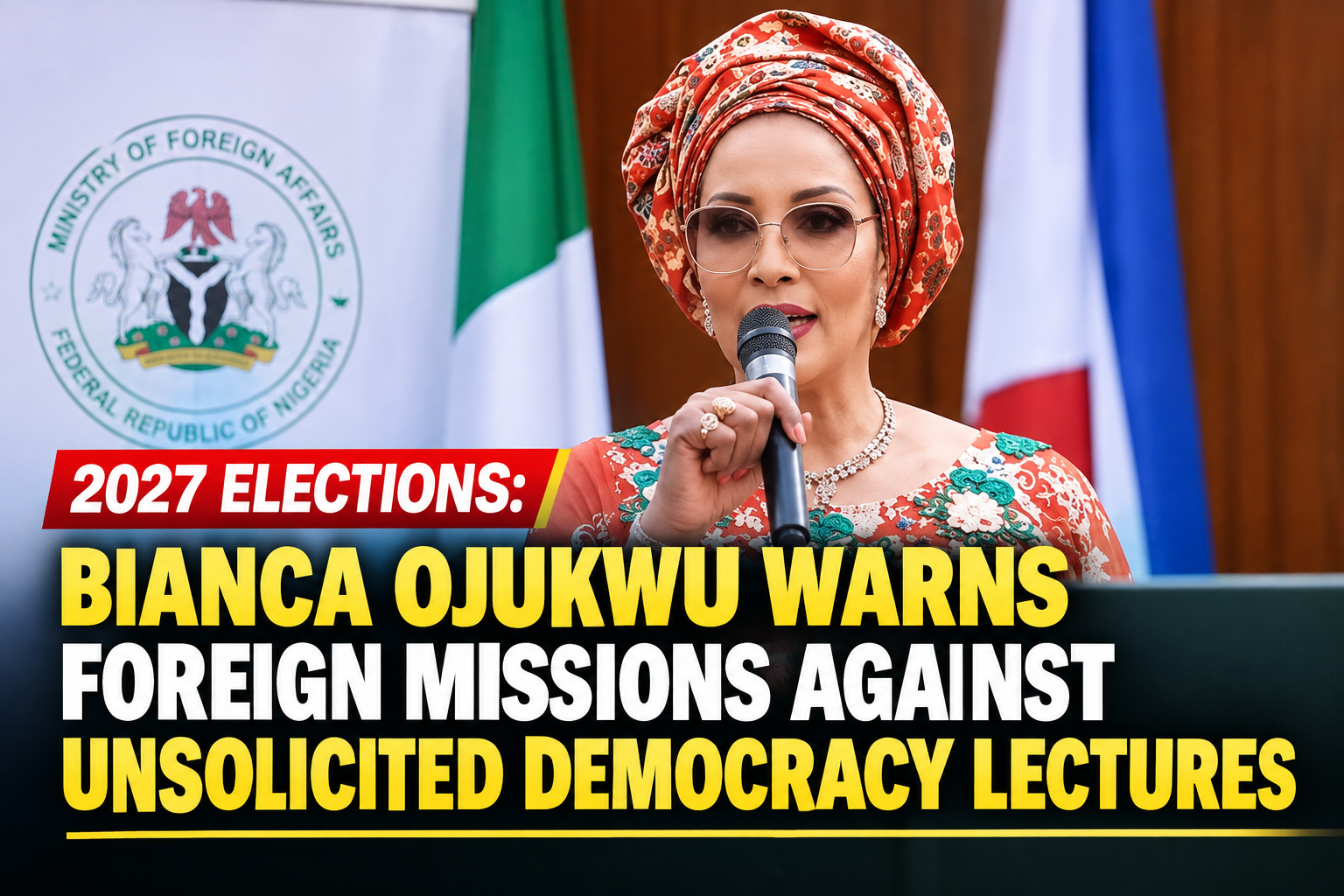
Nigeria's Minister of Foreign Affairs, Ambassador Bianca Odumegwu-Ojukwu, has cautioned foreign diplomatic missions against making unguarded or disparaging public comments about Nigeria as the country prepares for the 2027 general elections.
The minister issued the warning on Thursday, September 17, 2026, during her first formal engagement with members of the Diplomatic Corps since becoming Foreign Affairs Minister. The meeting was held at the Ministry of Foreign Affairs in Abuja.
Odumegwu Ojukwu said Nigeria's position as Africa's largest democracy means political developments in the country can have consequences beyond its borders. However, she urged foreign missions to respect Nigeria's sovereignty, democratic processes and established diplomatic channels.
She specifically cautioned against what she described as “unguarded comments, disparaging remarks, or unsolicited lectures on democracy” as the 2027 elections approach.
Government promises credible 2027 election
While warning foreign missions, the minister also sought to reassure the diplomatic community about the Federal Government's position on the forthcoming election.
She said President Bola Ahmed Tinubu's administration remained committed to democracy and to conducting an election that would be peaceful, free, fair and credible.
The statement places the responsibility for the credibility of the electoral process primarily within Nigeria's democratic institutions, while asking foreign governments and diplomatic representatives to engage through appropriate diplomatic channels.
Why the warning matters
Foreign governments and diplomatic missions regularly monitor political developments in countries where they operate. Their statements can attract significant public attention, particularly during elections, when questions about democracy, human rights and the credibility of electoral processes often receive international scrutiny.
Odumegwu-Ojukwu's message is therefore about maintaining a distinction between diplomatic engagement and public political intervention.
The minister called for issues to be handled through dialogue, mutual respect and established diplomatic procedures. She also asked foreign missions to route official communications and requests intended for Nigerian government institutions through the Ministry of Foreign Affairs.
At the same time, the government's pledge to hold a peaceful, free, fair and credible election means Nigerians will continue to pay close attention to how electoral institutions and political actors conduct themselves as the 2027 polls approach.
What it means for Nigerians
For ordinary Nigerians, the immediate effect of the minister's warning is likely to be diplomatic rather than economic.
The bigger issue is what happens to the electoral process itself.
A credible election can affect Nigerians directly because elections determine who occupies public offices and who makes decisions on issues such as security, jobs, education, healthcare, infrastructure and the economy.
The government's promise of a free and fair election will therefore be measured by what Nigerians experience during the electoral process, including the treatment of voters, the conduct of political parties and candidates, the work of electoral institutions, and the handling of disputes.
The minister's comments also signal that the Federal Government wants Nigeria's sovereignty to remain central to its engagement with foreign governments. For Nigerians, this raises two related issues: the importance of protecting Nigeria's independence in its international relations and the importance of maintaining public confidence in the country's own democratic institutions.
Foreign policy focus shifts toward citizens
Beyond the 2027 elections, Odumegwu Ojukwu said Nigeria's foreign policy should produce tangible benefits for citizens.
She highlighted trade, investment, security, education, technology, health and agriculture as areas where diplomatic relationships should generate practical results.
She also said the administration's foreign policy framework is built around the Four Ds — Demography, Development, Democracy and Diaspora with Nigerians placed at the centre of international engagement.
The minister further urged foreign missions to review lengthy visa-processing procedures affecting Nigerian applicants, noting that delays can create difficulties for legitimate travellers, students, businesspeople and families.
Nigerians' reaction
The minister's warning has the potential to generate different reactions among Nigerians because it touches on two competing concerns: national sovereignty and scrutiny of democratic governance.
Some Nigerians may view the position as an appropriate reminder that foreign diplomats should respect Nigeria's sovereignty and conduct political engagement through diplomatic channels.
Others may focus on the government's commitment to a credible election and argue that what matters most is not simply what foreign missions say, but whether Nigerian institutions provide an electoral process that earns public confidence.
The available reports on the briefing do not provide a representative nationwide survey of Nigerians' views, so individual social-media reactions should not be presented as evidence of a general public consensus.
The road to 2027
With the 2027 general elections approaching, diplomatic attention to Nigeria is likely to remain significant because of the country's regional influence and large population.
Odumegwu-Ojukwu's message is that foreign missions should engage Nigeria constructively while respecting its sovereignty and diplomatic procedures.
For Nigerians, however, the most important test will be the actual democratic process: whether citizens can participate freely, whether electoral institutions perform their responsibilities effectively and whether the eventual results are handled according to the law.
The warning to foreign missions is therefore only one part of a much larger conversation about Nigeria's 2027 elections — a conversation in which the actions of Nigerian institutions, political actors and voters will ultimately be central.